How Instagram's Algorithm Impacts Posting Times
Timing matters: post when followers are active, prioritize saves and shares, and test posting windows to boost reach and discovery.
Timing matters: post when followers are active, prioritize saves and shares, and test posting windows to boost reach and discovery.
4.98 /5 - from 58k reviews
Trusted by 50,000+ creators — get real engagement delivered to your profile in minutes, not days.
Instagram's algorithm prioritizes timing when deciding how widely to share your posts. Here's what matters most:
To maximize reach:
Pro Tip: Reels perform best in the evening (7–11 PM), while Feed posts and Carousels work well during mid-morning or lunch breaks.
Understanding your audience's habits and timing your posts accordingly can significantly improve engagement and reach.
Instagram relies on four distinct ranking systems - Feed, Stories, Explore, and Reels - each designed to align with different user behaviors and intentions.
Adam Mosseri explains it clearly:
"People tend to look for their closest friends in stories, use explore to discover new content and creators, and be entertained in reels."
This means user behavior varies depending on where they are within the app. For example, someone scrolling through Stories early in the morning has a different mindset than someone binge-watching Reels late at night. The algorithm recognizes these patterns, and your posting strategy should adapt to these differences.
Timing plays a critical role in how Instagram ranks content. The algorithm evaluates several key signals tied to when you post.
Freshness is a major factor. Both Feed and Stories prioritize new posts, so if you publish hours before your audience is even online, your content might seem outdated by the time they log in. A practical tip? Posting around 5 AM local time gives your content a chance to be indexed before the mid-morning activity spike.
For Reels, watch time is crucial. Reels that achieve a 75%+ average watch completion rate within their first hour are often pushed to a broader audience, including non-followers. This kind of performance is much easier to achieve during peak viewing times when your audience is actively engaging with content.
Another shift to note: as of 2026, saves and shares matter more than likes. A post with 50 saves can rank higher than one with 500 likes. This means timing your posts for when your audience has the time to engage deeply - saving or sharing rather than just tapping "like" - is more important than ever.
These signals emphasize the importance of aligning your posting schedule with your audience's habits to maximize reach and interaction.
While the algorithm's timing signals are critical, the best posting time ultimately depends on your specific audience. Instagram ranks content based on how well it predicts a post will resonate with each viewer. This makes generic advice about "best times to post" only a starting point.
Different audiences have unique scrolling patterns. For instance, a fitness account with early risers in the Mountain Time Zone will have a completely different optimal posting window than a nightlife brand catering to East Coast users. Posting at 11 AM EST might work wonders for one but flop for the other.
This is why your audience data is more valuable than generic benchmarks. While industry averages provide a helpful baseline, they can't account for the specific habits of your followers. The best way to pinpoint your ideal posting times is by analyzing when your audience is most active, a task made simple by using Instagram analytics to track engagement patterns.
If you have a Business or Creator account, head to Profile > Insights > Total Followers > Most Active Times to access a heatmap that shows when your audience is online, broken down by hour and day of the week. Pay attention to metrics like Total Plays for Reels, Reach, and Saves/Shares - these can help you understand how different time slots impact engagement. Zero in on two or three one-hour blocks with the highest activity and treat those as your go-to posting windows.
Another key metric to watch is your "Non-follower reach percentage." If certain time slots consistently show a higher reach from non-followers, it’s a sign that your content is extending beyond your core audience. These insights provide a solid foundation for fine-tuning your posting schedule.
Your past posts hold valuable clues about what works - and when. Instead of just focusing on likes, analyze your posts based on Saves, Shares, and Reach. Since 2026, Instagram's ranking model has placed about three times more weight on saves and shares compared to likes, making these metrics far more important for understanding effective posting times.
Look for patterns between posting times and engagement velocity - how quickly your posts gain meaningful interactions. For accounts with fewer than 10,000 followers, aim for an 8–12% engagement rate within the first 90 minutes. For accounts with 10,000 to 100,000 followers, the target is 4–7%.
"Miss the opening window and the post enters time-decay territory where it will not recover regardless of quality." - Maria, Senior Content Strategist, Socialfy24
Also, keep an eye on format-specific trends. Reels and Carousels often perform best at different times. Currently, Carousels have a slight edge with a win rate of around 0.55% compared to a baseline of 0.45%, but posting during off-peak hours can erase that advantage.
Once you’ve reviewed your past performance, use industry benchmarks to refine your posting frequency further.
Industry benchmarks are a great way to set an initial posting schedule, especially if you’re just starting to analyze your audience’s behavior. For example, a study of 7 million Instagram posts found that 7 AM is often the best time to post for maximum reach. Wednesday also stands out as one of the top-performing days.
Some recommended posting windows include:
For Reels, the evening slot (6–9 PM) tends to perform well since people are more likely to consume video content as leisure entertainment.
"Wednesday at 7–9 am EST is one of the single best moments to post on Instagram in the US. This... reflects a consistent pattern in American social media behaviour." - Hopper HQ
Stick to these benchmarks for 4–6 weeks to gather enough data. This will help you determine whether your audience aligns with general trends or follows its own unique rhythm.
If you want to take your analysis a step further, tools like UpGrow can be a game-changer. With its real-time analytics and smart targeting features, you can fine-tune your posting strategy to ensure you’re reaching your audience at the right moments.
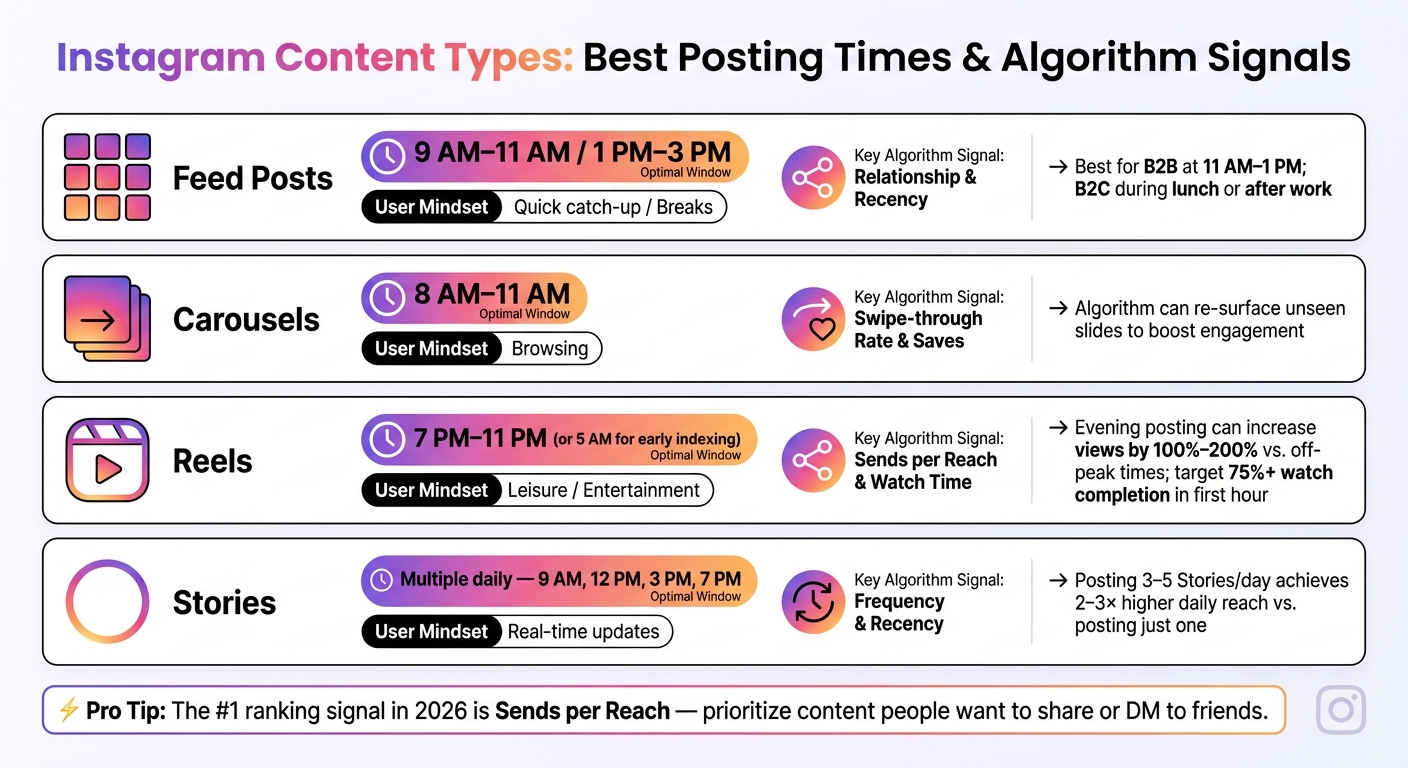
Instagram Content Types: Best Posting Times & Algorithm Signals
Using audience behavior data, you can fine-tune your posting schedule to match the unique characteristics of Instagram content formats. The algorithm treats Feed posts, Reels, and Stories differently, so syncing your timing with each format's strengths can lead to better engagement.
Feed posts work best during short breaks when users are casually scrolling through their phones. The ideal times are generally 9 AM–11 AM or 1 PM–3 PM.
Carousels, in particular, have a unique advantage. If a user skips swiping through a carousel the first time, Instagram’s algorithm might re-surface it later, starting from the first unseen slide. This makes the 8 AM–11 AM window especially effective for boosting swipe-through rates and saves. For B2B content, traditional work hours (around 11 AM–1 PM) tend to yield better results, while B2C and retail content often perform better during lunch breaks or after work.
While Feed posts thrive in these short scrolling windows, Reels require a different strategy.
Reels are designed for shareability and entertainment, making them most effective when users are in a relaxed, browsing mindset - typically between 7 PM and 11 PM. Posting Reels during these evening hours can increase views by 100% to 200% compared to other times. For an early advantage, publishing Reels as early as 5 AM allows the algorithm time to index and distribute the content before the 9 AM peak.
Stories, on the other hand, follow a different set of rules.
Stories rely heavily on Instagram’s relationship-first ranking system, which prioritizes the order of Stories based on how often followers interact with your account through DMs, reactions, or replies. Frequency is just as important as timing here. Accounts that post 3–5 Stories per day achieve 2–3× higher daily reach than those posting just one, as each new Story refreshes your visibility in followers’ Story trays.
To stay visible throughout the day, spread your Stories across multiple times - such as 9 AM, 12 PM, 3 PM, and 7 PM - to align with your followers’ daily routines.
| Content Type | Optimal Window | Primary User Mindset | Key Algorithm Signal |
|---|---|---|---|
| Feed Posts | 9 AM–11 AM / 1 PM–3 PM | Quick catch-up / Breaks | Relationship & Recency |
| Carousels | 8 AM–11 AM | Browsing | Swipe-through rate & Saves |
| Reels | 7 PM–11 PM | Leisure / Entertainment | Sends per reach & Watch time |
| Stories | Multiple (e.g., 9 AM, 12 PM, 3 PM, 7 PM) | Real-time updates | Frequency & Recency |
Start by establishing a baseline schedule. For many accounts, posting between Tuesday and Thursday, from 7 AM to 9 AM, tends to perform well across industries in 2026. However, this is just a starting point. To refine it, dive into Instagram Insights. Go to Insights > Total Followers > Most Active Times to identify when your audience is actually online. While general benchmarks provide a good starting framework, your own analytics will reveal the best posting windows for your specific followers.
Once you’ve set your baseline, the next step is to test and tweak your schedule based on how your audience engages with your posts.
Think of your baseline as an experiment. Over the course of 4–6 weeks, test different posting times while keeping your content consistent. Track metrics like engagement rates, reach, and saves to see what works best. For instance, you could post a Reel at 7 PM one week and 9 PM the next, comparing which time generates better completion rates.
Tim Eisenhauer of Apaya offers a valuable perspective:
"The best time to post on Instagram is whenever you'll post consistently. Generic advice like 'Tuesday at 11 AM' is based on averages that don't apply to your specific audience."
Consistency is more important than nailing a so-called "perfect" time. Regular, daily posting tends to outperform sporadic attempts to hit ideal time slots when it comes to long-term growth. Once you’ve nailed down a consistent routine, it’s time to factor in audience time zones.
If your followers are spread across multiple regions, focusing only on your local time can limit your reach. In fact, accounts that fail to consider their audience’s primary time zone see engagement drop by an average of 31%. The solution? Post multiple times a day. By scheduling 2–3 posts daily spaced at least six hours apart, you can target peak engagement windows across different regions without compromising performance. In 2026, accounts using this strategy achieved 52% higher overall reach compared to those posting just once per day.
If most of your audience resides in one region, you can simply optimize for their time zone. But for more diverse audiences, here’s a handy guide:
| Audience Split | Recommended Approach |
|---|---|
| 70%+ in one region | Focus entirely on that time zone |
| Split across 2 regions | Post twice daily to cover each region’s peak |
| Global/distributed | Post three times daily using a UTC-based calendar |
To keep things running smoothly across time zones, maintain your content calendar in Coordinated Universal Time (UTC). Don’t forget to adjust for Daylight Saving Time changes, especially if your audience spans both the US and Europe, where DST shifts occur on different dates.
Fine-tuning your Instagram posting schedule isn’t about finding a magic time slot - it’s about understanding how the algorithm works and creating a consistent posting routine that fits your audience’s habits.
Sophie Gonçalves, Content Manager at Iconosquare, sheds light on a key shift in Instagram’s algorithm:
"Instagram's algorithm now prioritizes 'sends per reach' (how often people share or DM your content to a friend). This is now the most critical signal, surpassing initial likes and comments."
To make the most of this, aim to post during moments when your audience is most likely to engage and share. The first 15–20 minutes after posting are crucial, as this is when your content has the best chance to gain momentum. By timing your posts just ahead of your audience’s peak activity, you can maximize early engagement and boost your reach.
Use Instagram Insights and continuous testing to refine your schedule based on how your audience actually interacts with your content. These tools help you connect earlier strategies with long-term success, ensuring your approach evolves with your audience.
In the end, consistency, actionable data, and shareable content matter far more than chasing after an elusive "perfect" posting time. Accounts that post regularly, focus on content that encourages shares, and adapt based on performance metrics are the ones that see steady growth - even as the algorithm changes.
For even more advanced strategies, consider tools like UpGrow to take your Instagram growth to the next level.
To get more engagement right off the bat, aim to post when your audience is most active. Even though Instagram's algorithm extends content visibility over 48–72 hours, those initial likes, comments, shares, and saves play a big role in signaling quality and boosting reach. Check out Instagram Insights to figure out when your followers are online the most. If you’re looking for a professional edge, tools like UpGrow’s AI-powered analytics can provide real-time data and smart targeting to help you drive organic engagement and expand your audience.
When your audience is spread across various time zones, sticking to generic posting times just won't cut it. Instagram's algorithm works to distribute content over a period of 48–72 hours, so understanding when your followers are most active becomes key. Dive into Instagram Insights to analyze activity patterns specific to your audience.
To take it a step further, scheduling tools can help you post at times that align with your followers' local time zones. This approach increases the chances of better engagement and ensures your content reaches the right people at the right time.
Yes, different types of content call for tailored posting schedules because of varying user habits and how algorithms work. Reels tend to get the most engagement early in the morning (5–6 AM) or during the evening (6–9 PM). Feed posts shine during commute times (6–9 AM) or around midday (11 AM–1 PM). Since Stories are short-lived, they perform best in the early morning or evening (7–9 PM). Tools like UpGrow can help you track your audience's activity to find the best times to post.