
Table of contents
- HOW TO DISCLOSE A BRAND PARTNERSHIP AS A CREATOR | DO I NEED TO USE THE PAID PARTNERSHIP LABEL?
- What counts as compensation under Instagram policy
- Who can pay, who must disclose, and when the Paid partnership label applies
- How creators and brands stay within Instagram policy
- Instagram tools, eligibility limits, enforcement risks, and conclusion
- FAQs

If you get cash, free products, travel, discounts, or commission for an Instagram post, you should disclose it. In most cases, that means using Instagram’s Paid partnership label, tagging the brand, and adding plain words like “ad,” “sponsored,” or “I earn a commission.”
Here’s the short version:
- If a brand gives me anything of value, the post may count as branded content.
- That value can be money, gifts, hotel stays, event access, free software, discount codes, or affiliate pay.
- If payment comes through an agency or network, I still disclose the brand, not the middleman.
- Instagram’s label helps with platform rules, but it does not always cover FTC disclosure by itself.
- A short line like “Ad,” “Sponsored by [Brand],” or “I may earn a commission” should be easy to see.
- Each sponsored post in a campaign should be labeled - not just the first one.
- If a brand wants to run my post as an ad, that needs separate permission.
A few gray areas matter too. A single gifted item can trigger disclosure if I feature it. Affiliate-only posts still need clear wording before the link. And if a brand gave talking points, asked for approval, or shaped the post, that is a strong sign I should disclose.
The safest rule is simple: if value changed hands and a business is tied to the post, disclose it clearly and keep records.
HOW TO DISCLOSE A BRAND PARTNERSHIP AS A CREATOR | DO I NEED TO USE THE PAID PARTNERSHIP LABEL?
sbb-itb-3c55afb
What counts as compensation under Instagram policy
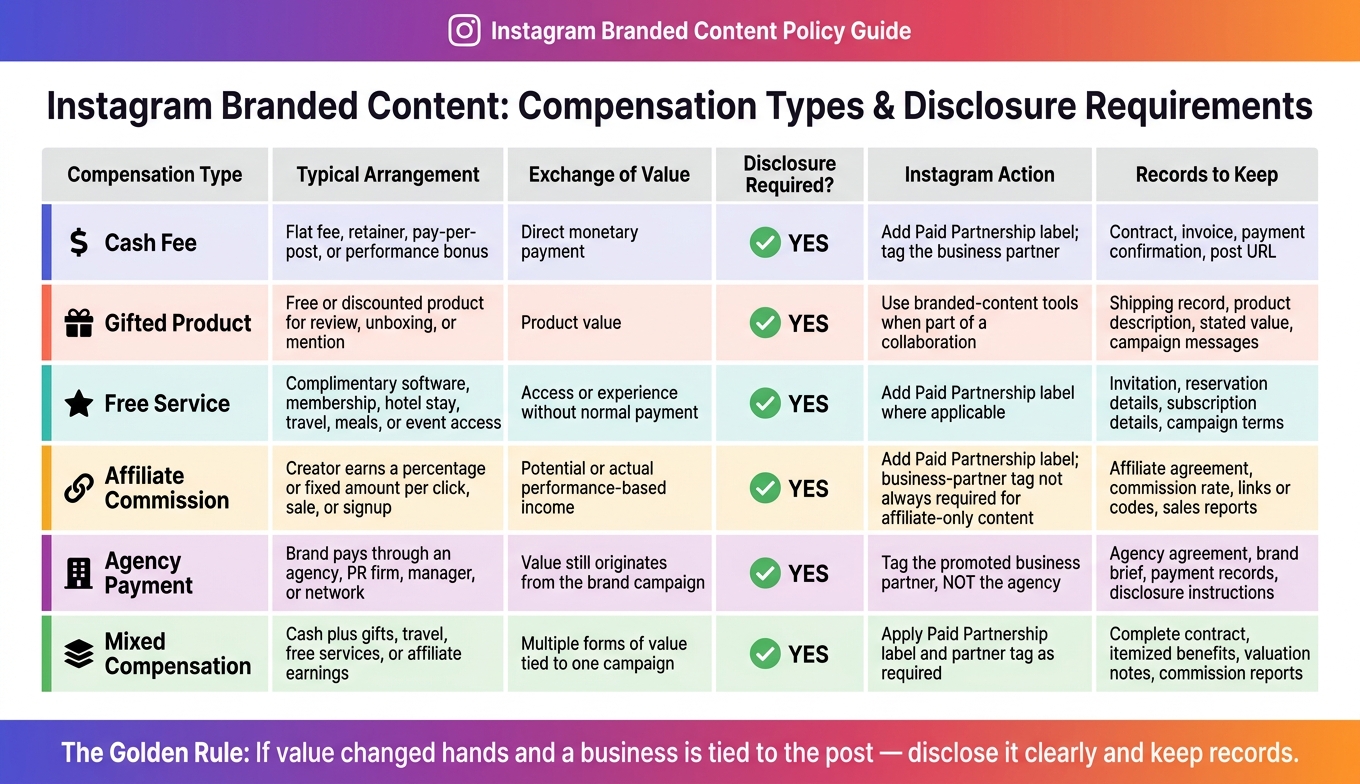
Instagram Branded Content Compensation Types & Disclosure Requirements
If a business gives you anything of value in exchange for featuring or promoting it, Instagram treats that post as branded content. This section is about what, exactly, counts as compensation.
Cash, gifted products, free services, and affiliate commissions
Cash compensation covers the usual paid setups: flat fees, pay-per-post deals, monthly retainers, and performance bonuses. If you're part of a paid campaign, label every post in that campaign, not just the first one.
Non-cash value counts too. A free product sent for review, a complimentary software subscription, a sponsored hotel stay, airfare, meals, or VIP event access all qualify as compensation. The same goes for a discount given in exchange for coverage.
Affiliate links and discount codes also create a paid relationship. If a creator earns a commission from sales tied to a link or code, that commission counts as compensation. Use plain language like "affiliate" or "commission". Don't swap that out for "partner."
If a deal includes cash plus gifts, travel, free services, or affiliate earnings, Instagram still sees it as one compensated collaboration.
Agency-arranged payments and off-platform pay rules
The disclosure rule doesn't change just because money moves through someone else. If a brand pays through an agency, PR firm, manager, or affiliate network, the relationship still needs to be disclosed. Tag the brand, not the agency.
Fees, deliverables, and payment terms are handled off-platform between the creator and the brand, or the brand's representative. The table below shows how that applies across common payment models.
Compensation models and disclosure requirements: comparison table
Use the table below to match each type of compensation with the right disclosure.
| Compensation type | Typical arrangement | Exchange of value | Disclosure required | Instagram action | Records to keep |
|---|---|---|---|---|---|
| Cash fee | Flat fee, retainer, pay-per-post, or performance bonus | Direct monetary payment | Yes | Add the Paid partnership label; tag the business partner | Contract, invoice, payment confirmation, post URL |
| Gifted product | Free or discounted product for a review, unboxing, or mention | Product value | Yes, when the product is featured or endorsed | Use branded-content tools when part of a collaboration | Shipping record, product description, stated value, campaign messages |
| Free service | Complimentary software, membership, hotel stay, travel, meals, or event access | Access or experience without normal payment | Yes, when connected to the content or endorsement | Add the Paid partnership label where applicable | Invitation, reservation details, subscription details, campaign terms |
| Affiliate commission | Creator earns a percentage or fixed amount per click, sale, or signup | Potential or actual performance-based income | Yes; disclose the commission relationship clearly | Add the Paid partnership label; a business-partner tag is not always required for affiliate-only content | Affiliate agreement, commission rate, links or codes, sales reports |
| Agency payment | Brand pays through an agency, PR firm, manager, or network | Value still originates from the brand campaign | Yes; the intermediary does not remove the underlying relationship | Tag the promoted business partner, not the agency; payments remain off-platform | Agency agreement, brand brief, payment records, disclosure instructions |
| Mixed compensation | Cash plus gifts, travel, free services, or affiliate earnings | Multiple forms of value tied to one campaign | Yes; disclose every form of value | Apply the Paid partnership label and partner tag as required | Complete contract, itemized benefits, valuation notes, commission reports |
Who can pay, who must disclose, and when the Paid partnership label applies
Who may pay or provide value in a collaboration
Once value enters the picture, the next step is figuring out who provided it and who needs to disclose it.
That value can come straight from the brand, or from someone working on its behalf, like an agency, PR firm, manager, affiliate network, retailer, or another representative. Instagram's branded-content policy looks at whether there was an exchange of value, not who actually paid.
Personal, family, employment, or ownership relationships can also count as a material connection under FTC guidance, even when no campaign fee changed hands.
The creator who publishes the post is the one responsible for making the disclosure. Brands and agencies still have work to do too: they should brief the creator and review the post.
A simple disclosure test to run before posting
Use this quick check before every branded post:
- Did I receive or expect anything of value?
- Did the brand or its representative request, influence, approve, or arrange the post?
If the answer is yes, disclose.
Use plain language in the caption or on-screen text, such as Ad, Sponsored by [Brand], or I may earn a commission. Put it before the tap-to-expand point. Don't bury it after that line or hide it in hashtags.
If the partner also gave direction or approved the content, add Instagram's Paid partnership label and tag the business. That label can help with Instagram compliance, but it does not replace every legal disclosure rule.
Gray areas that confuse creators most
These are the cases that trip people up most often.
Gifts with no formal contract are a big one. No written agreement? That doesn't settle it. If a brand sends you a free or discounted product or service and you feature or endorse it, that benefit may still count as a material connection. The FTC says a generic label like gifted can be unclear. A more specific label, such as gifted by [Brand], makes the source clearer when the creator received only a free product.
Affiliate-only posts also need clear disclosure before the click. Say it plainly: I may earn a commission if you buy through my link. Affiliate content should also be checked under Instagram's branded-content rules, and the Paid partnership feature may apply when the affiliate partner is a business partner and the creator is earning commissions.
A single gifted item still needs disclosure if it appears in the post. A broad line like some items were gifted may be less clear because it doesn't show which product is tied to the benefit. A better example: The blender was gifted by [Brand].
If the brand supplied talking points, asked for the post, or sent merchandise, disclose that connection.
How creators and brands stay within Instagram policy
Once compensation is clear, use these checks before you post.
Creator checklist for compliant branded content posts
Before you say yes to a deal, get the terms in writing. Spell out the brand name, deliverables, compensation, deadlines, approvals, disclosure duties, usage rights, exclusivity, cancellation terms, and when payment will be sent.
Before publishing, review this short checklist:
- Confirm compensation terms are documented - cash, free or discounted product or service, affiliate commission, or any other benefit.
- Add the Paid partnership label and tag the correct business partner. Then make sure both appear correctly on the final post, Reel, or Story.
- Use a clear disclosure in the same format as the post, near the top of the caption or visible long enough in Stories and video.
- Check every claim - only say what you can back up and what fits your genuine experience. Don't promise guaranteed results or make unsupported performance claims.
- Save the contract, invoices, payment proof, delivery records, affiliate terms, approval messages, and screenshots of the final post. File them under the campaign name and publication date, using U.S. date format and U.S. dollars for amounts.
If the brand wants to boost the post as a partnership ad, turn on the "Allow brand partner to boost" setting separately. That setting is not the same thing as the Paid partnership label.
Brand and agency checklist for compliant campaign management
Brands and agencies need the same level of care on approvals, claims, and recordkeeping.
Use a written brief that covers deliverables, deadlines, payment, usage rights, exclusivity, approvals, disclosures, approved claims, and correction steps.
A few points often get missed:
- Verify the business-partner tag. Make sure the creator picked the correct official business account before the post goes live.
- Secure ad permissions separately. A Paid partnership label does not give you permission to boost. Get account-level or content-level partnership-ad permission before boosting, and note that creators can revoke that permission.
- Never instruct creators to hide compensation. Phrases like "don't mention the gift" or "put the disclosure at the end" put both sides at risk. The FTC expects material connections to be disclosed clearly and conspicuously.
Keep contracts, invoices, content approvals, post URLs, and performance reports for the time period set in the contract or your internal recordkeeping policy.
Where an Instagram-compliant growth tool fits
Growth tools can help with reach, but they don't change the rules for disclosures or labels.
If you use a growth service, it still needs to stay within Instagram rules - no bots, fake followers, unauthorized automation, or password sharing. UpGrow can support compliant audience growth, but disclosures still need to be handled on their own.
Instagram tools, eligibility limits, enforcement risks, and conclusion
Branded-content tools, Creator Marketplace, and partnership ad eligibility
Once disclosure is in place, the next step is knowing which Instagram tools apply. Instagram’s branded-content tools each do a different job.
| Tool | What it does | Key requirements |
|---|---|---|
| Paid partnership label | Identifies a commercial relationship in organic content | Policy compliance, partner permission, eligible account |
| Creator Marketplace | Helps brands and creators find and manage collaborations | Age 18+, professional public account, 1,000+ followers, must follow Meta's partner monetization policies |
| Partnership ads | Lets advertisers promote eligible creator content as paid ads | Public post, professional account, creator-granted ad permission |
Here’s the plain-English version:
- Use the Paid partnership label for disclosure
- Use Creator Marketplace to find and manage brand deals
- Use partnership ads when a brand wants to turn creator content into paid ads
One detail trips people up all the time: partnership ads need separate ad permission. A label alone doesn’t cover that.
And hitting the basic profile rules doesn’t mean access is automatic. Meta also looks at whether the account has a real audience, follows platform rules, and has a clean history. Before you promise a brand anything, check the current Professional Dashboard or branded-content settings.
What can happen if disclosure is missing or inaccurate
If access settings are wrong or disclosure is missing, a post can run into trouble before anyone even sees it. Missing, weak, or hard-to-find disclosures can lead to content rejection, lower reach, loss of features, or account restrictions.
In the United States, the FTC treats hidden material connections as a consumer-protection issue. That means this isn’t just an Instagram housekeeping problem.
A few common mistakes can create trouble fast:
- Naming the wrong brand in the label
- Hiding disclosure inside a pile of hashtags
- Posting a sponsored Story with no disclosure at all
Any of those can create platform risk and legal risk. If a post gets flagged, fix the disclosure first. Then check whether the account lost any access or permissions.
Conclusion: the simplest way to stay compliant
The core rule is pretty simple. Compensation is not just cash. Free products, services, affiliate commissions, discounts, and loaned items can all count. Agencies can also pay on a brand’s behalf, and the disclosure duty follows the thing of value, not only the payment method.
Use Instagram’s Paid partnership label. Tag the correct business partner. Add plain-language disclosure when the format calls for it. Get the needed permissions before boosting. Keep records of each step.
Use the label, add clear disclosure, and keep records.
FAQs
Do I need to disclose gifted products?
Yes. Under FTC guidelines, free products, PR packages, or other perks create a material connection. If you post about them, you should disclose that connection clearly - even if no one paid you and no one asked you to post.
Use clear labels like Gifted by [Brand] or PR package from [Brand]. Skip vague terms like partner or just tagging the brand.
Is the Paid partnership label enough?
No. The Paid partnership label is the starting point, not the whole job.
The FTC says disclosures must be clear and easy to understand. That means the platform label should appear alongside plain-language wording like Ad or Sponsored at the start of the caption, or shown clearly on-screen in videos.
Can a brand boost my post automatically?
Yes, but only with your explicit approval.
With partnership ads, a brand can promote your eligible content from its own Meta Ads Manager account. After you approve it, the brand can decide the content, budget, audience, and placements.
It can also run ads from your handle without an existing organic post, as long as you authorize it.


