
Do Local Hashtags Still Work on Instagram?
Local Instagram hashtags still help as support signals—use 1–2 hyperlocal tags in a 3–5 set and pair with geotags, keywords, and Reel text.
Local Instagram hashtags still help as support signals—use 1–2 hyperlocal tags in a 3–5 set and pair with geotags, keywords, and Reel text.
4.98 /5 - from 58k reviews
Trusted by 50,000+ creators — get real engagement delivered to your profile in minutes, not days.

Yes - but they don’t drive Instagram growth on their own anymore. In 2026, I’d treat local hashtags as support signals, not the main lever. If you want nearby people to find your posts, Reels, or Stories, I’d put more weight on geotags, local keywords, on-screen text, and watch time than on hashtags alone.
Here’s the short version:
#WilliamsburgCafe tend to work better than broad tags like #NYC.If your goal is local foot traffic, bookings, or nearby leads, local hashtags still have a place. But if your goal is broad awareness, they often do little and can narrow who sees your content.
| Where they help most | Where they help less | What I’d use with them |
|---|---|---|
| Local businesses, events, service-area creators | National or broad reach campaigns | Geotags, local keywords, Reel text, location stickers |
So my takeaway is simple: use local hashtags as labels, not as a reach hack. Keep them tight, rotate them when the post topic or area changes, and judge them by local actions - not by raw reach alone.
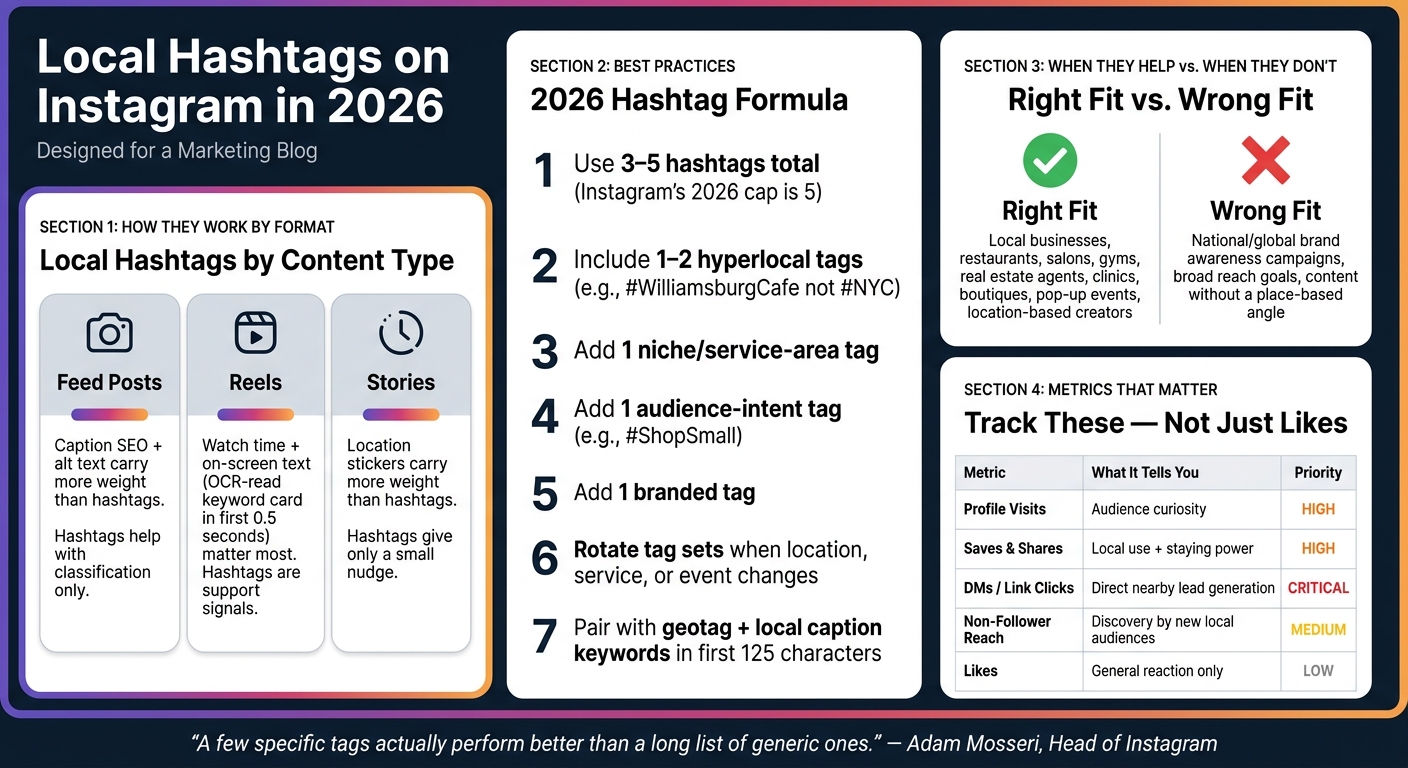
Local Hashtags on Instagram 2026: What Works, What Doesn't & What to Track
In 2026, local hashtags mostly help Instagram sort and label content. They don't push reach by themselves. Their role is small. Geotags, caption SEO, on-screen text, and watch time do most of the heavy lifting.
That plays out a bit differently across posts, Reels, and Stories.
For feed posts, Instagram leans more on caption SEO and alt text to figure out the topic and local fit. Hashtags still help with classification, but they aren't the main thing moving a post.
For Reels, watch time and on-screen text matter far more. Instagram also uses Optical Character Recognition (OCR) to read text shown on screen. So if you add a clear 1–3 word keyword card in the first 0.5 seconds of a Reel, it can help both people and the algorithm right away.
Specific neighborhood or venue tags also tend to work better than broad city tags, because the intent is clearer. #WilliamsburgCafe, for example, speaks to a tighter local audience than #NYC.
Stories follow a different pattern.
Stories lean more on location stickers than hashtags, and the sticker carries more weight. A local hashtag may give a Story a small nudge, but the location sticker does more.
Search and location pages now drive more local discovery than hashtag feeds. Public posts from professional accounts can also show up in external search results. That changes the game a bit: a well-written caption with local keywords can support discovery both inside Instagram and outside it, while hashtags mostly help confirm what the content is about.
That split by format helps show when local hashtags are worth using.
Local hashtags don't help across the board. They work best when place is part of the point.
This matters most when the content points to an actual local destination. Restaurants, salons, gyms, real estate agents, clinics, boutiques, and pop-up events are the clearest cases. These accounts need to reach people who can show up in person, and location-specific tags help signal that.
Local hashtags can lead to stronger nearby engagement than generic business hashtags. One healthcare clinic, for example, generated more than 742,000 verified views in three months by pairing Reels with focused local hashtags and location signals.
They tend to work best when used alongside:
The same tags tend to fall flat when geography isn't the point. If an account is aiming for national or global growth, local hashtags can narrow distribution. Unless the content has a clear place-based angle, these tags usually don't do much.
Use local hashtags only with geotags, local keywords, and on-screen text. Put together, those signals give Instagram a clearer sense of where the content fits. On their own, local hashtags are weak. Paired with other local signals, they can still help without making the post look spammy.
With hashtags now capped at five, the aim is precision, not volume.
A simple five-tag mix works well: 1–2 hyperlocal tags, 1 niche tag aimed at a service area, 1 audience-intent tag like #ShopSmall, and 1 branded tag tied to your business or campaign. That setup keeps your tags narrow enough to stay on-topic.
The next step is making sure they don't look copied and pasted on every post.
Using the same hashtag block on every post looks repetitive. Instead, rotate 3–5 sets and match each one to the post's theme or neighborhood. For example, swap in different neighborhood tags across posts instead of repeating the same block every time.
That kind of rotation helps each post line up with a certain place, event, or audience segment.
Hashtags work more like labels. They tell Instagram what a post is about, but they don't expand distribution by themselves.
For execution, pair them with the three signals that carry the most weight:
That mix matters more than the hashtag set alone.
These are the main edge cases: tag count, spam risk, and when to rotate tags.
Once you know how to use hashtags effectively, most of the debate comes down to volume, repetition, and timing.
Yes. Irrelevant or repeated tags can cut distribution. If you're working with a five-tag cap, stick to local tags that clearly match the post. Off-topic tags don't do much, and they can muddy the signal.
"A few specific tags actually perform better than a long list of generic ones." - Adam Mosseri, Head of Instagram
Use 3 to 5 hashtags total, with 1 or 2 local tags. That lines up with Instagram's 2026 recommendation. In most cases, a hyperlocal tag works better than a broad city tag because it gives Instagram a clearer location signal. If your caption and location cues are strong, a small group of precise hashtags is enough.
Tag count matters. But consistency matters too.
Rotate tags only when the post's location, service, or event changes. Don't switch them around at random just to avoid repetition. Keep your hyperlocal core tags steady, and swap in niche or seasonal tags when the content changes.
After you pick a few local tag sets and rotate them, judge them by the local actions they produce.
Don’t measure local hashtags by total reach alone. Measure them by what they get local people to do.
Open Instagram Insights after each post, but don’t get stuck on the total reach number. The signals that matter most are profile visits, saves, shares, DMs from nearby customers, and comments that mention a specific place or neighborhood. If one post gets fewer likes but more profile visits and DMs, that post is doing the better job.
Check your Top Cities breakdown on a regular basis. If new followers are piling up from places outside your service area, your tags are pulling in the wrong crowd. High non-follower reach only matters when those people are local, because that means your content is reaching new nearby customers.
| Metric | What It Tells You | Priority |
|---|---|---|
| Profile visits | Audience is curious enough to check you out | High |
| Saves & shares | Content has local use and staying power | High |
| DMs / link clicks | Direct lead generation from nearby users | Critical |
| Non-follower reach | Discovery by new local audiences | Medium |
| Likes | General reaction only | Low |
Use those signals to decide which tag sets stay in rotation.
Once a month, look back at the posts tied to each local tag set and compare the local actions they produced.
Cut any tag set that keeps failing to drive profile visits or engagement. Also search each tag on Instagram. If recent posts are hidden, the tag may be flagged, and it’s smart to drop it. Then swap in seasonal or event-based local tags. An upcoming street fair, a neighborhood festival, or a local market can all give you new tag ideas.
Local hashtags still work when they help the right nearby audience find the right content. The best results come when you pair them with local keywords, geotags, and regular measurement.


